Every year since 2017, I have run a statistical model to predict the winner of the Oscars. The model is based on data collected since 1995.
My models use variables like whether an actor or movie won a Golden Globe, BAFTA, or other award; the age of an actor; and how many previous nominations or wins an actor has to figure out which variables are the most predictive of winning an Oscar. In each category, it turns out that different variables are highly predictive of winning. For example, for Best Actress, winning the SAG Award the same year is one of the best predictors for winning the Oscar, but for Best Director, winning the Director’s Guild Award is a good sign for winning the Oscar. Then I generate predicted probabilities for each actor and movie in the major Oscars categories, plugging in data like whether they just won or were nominated for awards this cycle and other information.
The table below shows the film or nominee with the highest predicted probability of winning each category at the 2026 Academy Awards.
Update: 2026 Prediction Results – 10 of 12 correct (83%)
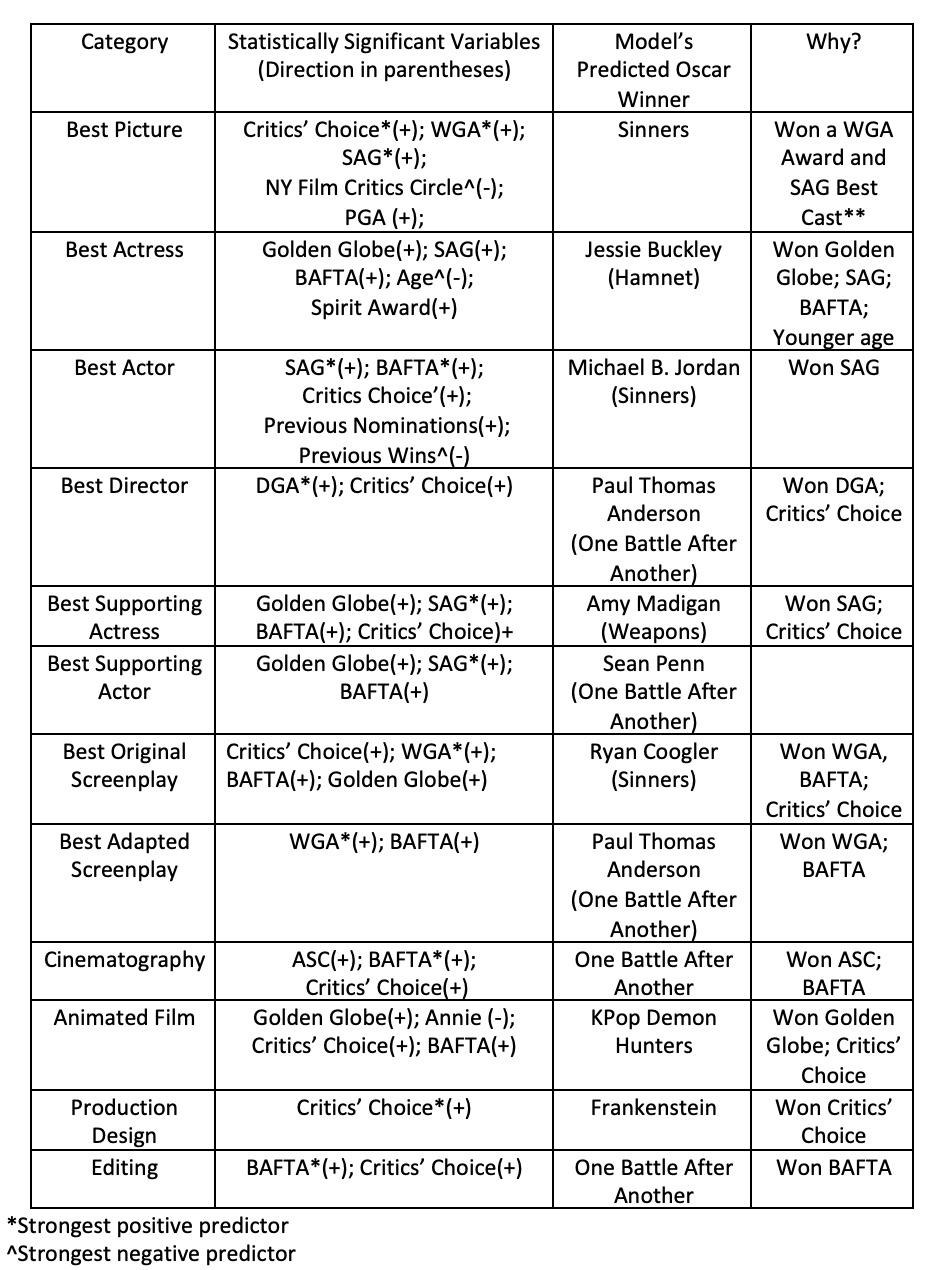
**Predicted probabilities indicate an incredibly close race between Sinners and One Battle After Another.
In the model for Best Picture, there are five statistically significant predictors. Four of these significantly increase the likelihood of a film winning Best Picture (SAG for Best Cast, Critics Choice for Best Picture, WGA Award for either Best Adapted or Best Original Screenplay, and PGA Award for Best Theatrical Motion Picture). The only predictor that significantly decreases a film’s chance of winning Best Picture is winning the New York Film Critics Circle Award for Best Film.
One Battle After Another has won three of the five positively signed significant predictors (PGA, WGA for Adapted Screenplay, and Critics Choice). Sinners have won two (SAG for Best Cast and WGA Award for Original Screenplay).
The slight advantage for Sinners in the model results from One Battle After Another having won the only negatively signed predictor (New York Film Critics Circle Award for Best Film)
 Ryan J. Williams